Products
Explore our advanced sequencing products for turning complex molecular signals into high-confidence readouts across clinical testing, RNA quality control, and translational methylation programs.

Accurate RNA analysis is essential for understanding gene expression, isoform diversity, and post-transcriptional regulation. As mRNA-based therapies and vaccines grow in prominence, poly(A) tail sequencing stands out as an emerging method for evaluating RNA stability, translation efficiency, and cell-specific expression.
Oxford Nanopore Technologies (ONT) has transformed the transcriptomics field through direct RNA sequencing, a method that reads native RNA molecules, including their poly(A) tails, without cDNA synthesis or amplification. This approach preserves RNA modifications and structural context, offering a level of biological fidelity unattainable with traditional short-read methods.
Poly(A) tails, the adenine stretches at the 3′ ends of mRNA molecules (Figure 1), govern transcript lifespan and translational potential. Conventional RNA sequencing (RNA-seq) methods rely on reverse transcription and PCR, which introduce biases that often obscure real biological variation.
ONT’s direct RNA (dRNA) sequencing, however, eliminates these artifacts by threading intact RNA molecules through nanopores and detecting changes in ionic current to decode sequence and modification patterns in real time. The result is single-molecule resolution of each transcript’s full architecture, from untranslated regions to poly(A) tails.
Validated ONT workflows have demonstrated reproducible poly(A) measurements free from PCR distortion, supporting applications from fundamental research to high-throughput screening1. In work benchmarking ONT’s dRNA against other RNA-seq protocols across seven different human cell lines, ONT outperformed short-read cDNA, amplification-free direct cDNA and PCR-amplified cDNA sequencing, and PacBio IsoSeq in correctly identifying isoform structures2.
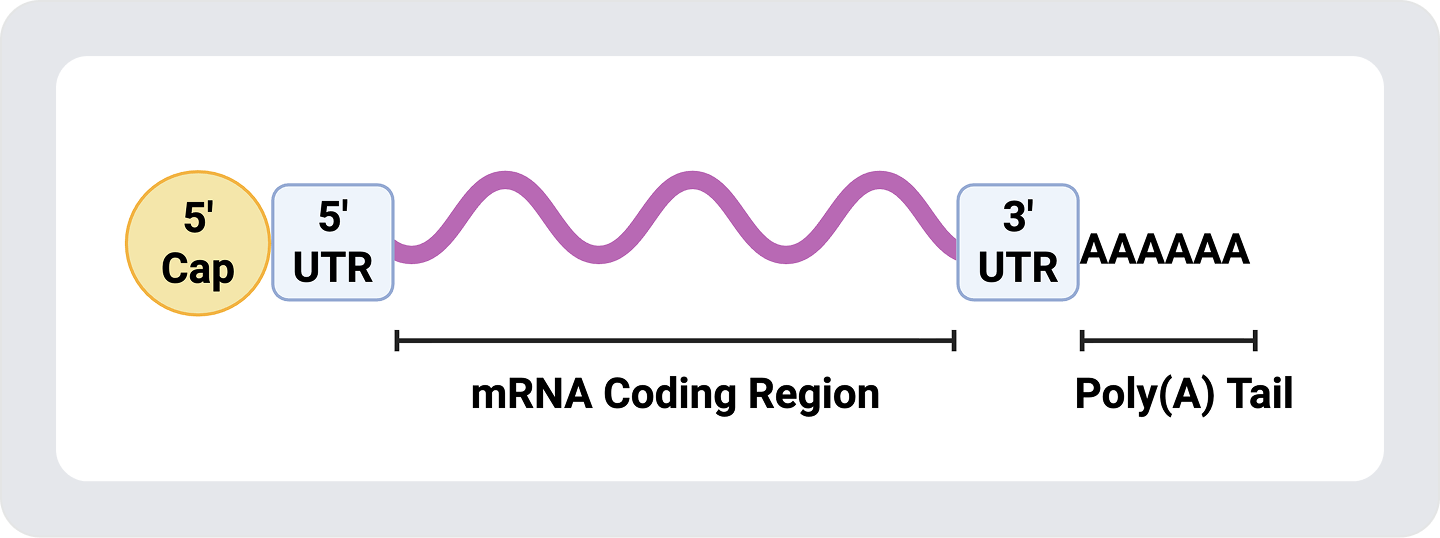
Figure 1. Anatomy of an mRNA molecule, including the 5’ cap, 5’ untranslated region (UTR), coding region, 3’ UTR, and poly(A) tail.
Quantifying RNA precisely has long challenged researchers. Amplification-based protocols often distort transcript abundance and mask subtle shifts in poly(A) length that affect regulation and stability.
ONT’s technology solves this by directly measuring transcript abundance, isoform structure, and tail length in the same molecule. Using synthetic RNA standards and spike-in controls, Chang et al. verified the platform achieves artifact-free, reproducible quantification even in heterogeneous samples3. These capabilities enable accurate RNA quantification for detailed mapping of post-transcriptional control and mRNA turnover, critical insights for both discovery and therapeutic design.
Because ONT sequences native RNA, it captures more than nucleotide order. It also detects epitranscriptomic marks such as m⁶A and pseudouridine, which, like DNA methylation or histone modifications, govern gene expression. Capturing multidimensional data, ONT reveals interactions between tail length, RNA modifications, and stability that are invisible to short-read or cDNA-based methods4,5. This integrated view is redefining transcriptomics in both research and clinical contexts.
In human models, ONT’s direct RNA sequencing has illuminated transcript-specific regulation of poly(A) tails and RNA modifications relevant to stem-cell biology, cancer, neurodegeneration, and gene therapy.
Beyond human transcriptomes, ONT has been used to map the interplay of splicing, alternative polyadenylation, and m⁶A modification in full-length mRNAs in plant model species like Arabidopsis thaliana (thale cress), revealing how these combined processes shape transcript diversity and stability6. Their findings demonstrate that nanopore sequencing captures the full complexity of RNA molecules, regardless of species, highlighting its versatility for studying transcript dynamics across and between species in research and clinical contexts.
High-resolution poly(A) profiling now enables researchers to dissect transcript diversity and isoform-specific regulation. Generating nearly ten million RNA reads with ONT poly(A) sequencing of human cells, Workman, et al. revealed more than 33,000 possible transcript haplotypes7. The study supports that dRNA sequencing captures full-length transcripts, including untranslated regions and poly(A), while preserving RNA modifications. The study showed that ONT provides a more complete view of transcriptome dynamics than amplification-based RNA-seq, revealing how tail heterogeneity, isoform structure, and RNA modifications collectively shape gene expression and cell state.
Poly(A) tail length directly influences mRNA stability and translational efficiency, making its accurate measurement essential for optimizing mRNA-based therapeutics8. Recent studies demonstrate that engineering or chemically modifying poly(A) tails can substantially enhance transcript performance, doubling protein output and extending RNA lifespan. For example, synthetic polyadenosine tail mimetics significantly increase gene expression in genes whose under expression is associated with autism spectrum disorders such as SYNGAP1, MECP2, PURA, and CTNNB19. Overexpressing these genes demonstrated a rescuing effect in vitro and in vivo, underscoring the potential of targeted tail engineering as a potential strategy for advancing precision therapeutics.
ONT enables the creation of multi-omic RNA biomarkers that unify transcriptional, epitranscriptomic, and structural insights, offering new opportunities for early detection, patient stratification, and real-time monitoring of disease progression. Real world applications emerging in oncology show isoform-specific poly(A) tail signatures distinguished tumor differentiation states and metastatic potential, directly linking RNA processing patterns to disease behavior4. ONT’s direct RNA sequencing is standing out in molecular diagnostic potential for capturing multiple RNA features from a single native molecule without traditional biases.
As RNA sequencing continues to expand into clinical diagnostics and therapeutic development, demand for high-fidelity, amplification-free data is accelerating. In rare-disease and oncology cohorts, transcriptomic analysis already improves diagnostic yield and uncovers actionable mechanisms10,11. Full poly(A) tail sequencing extends these benefits, offering a new dimension of molecular insight.
Global investment in RNA-based therapeutics and multi-omics integration projected to drive the transcriptomics market well beyond $7 billion in 202512. ONT’s technology is positioned at the center of this growth, especially with the recent announcement that RNA barcoding enables multiplexing of up to 24 samples per flow cell13.
Oxford Nanopore’s direct RNA sequencing sets a new standard for bias-free, single-molecule resolution analysis of poly(A) tails that captures structure, modification, and regulation in one assay. For researchers, it clarifies the complexity of RNA biology. For therapeutic developers and clinicians, it delivers the precision needed to design, validate, and monitor next-generation RNA medicines and diagnostics.
Renew Biotechnologies offers ONT poly(A) sequencing as part of our expert services. Whether your goal is to uncover transcriptome complexity, validate therapeutic constructs, or develop RNA-based clinical applications, our team provides the tools and insights to move your science forward.