Start A Project
Close-up of a clear plastic microplate with multiple round wells used in laboratory testing.

Overview

Telomere Sequencing is a specialized Oxford Nanopore Technologies (ONT) service for native long-read analysis of telomere length, subtelomeric structure, and adjacent epigenetic features. The workflow supports molecule-level characterization of telomere biology from extracted DNA without live-cell processing.
  • Arm-specific telomere length measurement across chromosome ends
  • Integrated subtelomeric methylation and structural variant analysis
  • Native DNA workflow using fresh or biobanked samples
  • Scalable study designs across research and translational applications
DNA icons
Telomere Characterization
Global and chromosome arm-specific telomere length analysis
Identification of short telomeres and telomere length heterogeneity
interesting process icon
Subtelomeric Profiling
Subtelomeric methylation and DMR characterization
Structural variant and adjacent genomic context analysis
dotted bow tie icon
Research & Translational Applications
Aging, oncology, and telomere biology research
Biomarker discovery and longitudinal cohort studies
Technology
Workflow
Performance
Data Outputs

Technology and Compatibility

Telomere Sequencing applies specialized ONT long-read sequencing chemistry to high-molecular-weight genomic DNA, enabling direct measurement of telomere length and subtelomeric structure from native DNA molecules.
  • Compatible with
  • High-molecular-weight DNA from human and other eukaryotic organisms
  • Fresh, frozen, cultured, and biobanked DNA samples
  • Research, translational, and telomere biology workflows
  • Component
    Technology
  • Sequencing Chemistry
    Native Oxford Nanopore DNA Sequencing
  • Preparation
    ONT-compatible telomere adapter ligation and enrichment
  • Sequencing Platform
    Oxford Nanopore PromethION

Workflow

Telomere Sequencing uses ONT’s specialized long-read telomere sequencing workflow for direct measurement of telomere length and subtelomeric structure from native DNA. Renew provides full-service support from high molecular weight (HMW) gDNA extraction through library preparation, sequencing, analysis, and data delivery.
  • 1. HMW gDNA Extraction
    High-quality genomic DNA is isolated from samples
  • 2. Library Preparation
    DNA is prepared using ONT-compatible Telo-Seq library preparation
  • 3. Long-Read Sequencing
    Native DNA sequencing is performed on the PromethION platform.
  • 4. Data Analysis
    Sequencing data are processed through automated analysis pipelines.
  • 5. QC Reporting
    Arm-level TL distributions, subtelomeric context visualizations
  • 6. Data Delivery
    Results are delivered through the customer portal or AWS S3.

Sequencing Performance

Coverage and yield vary depending on sample inputs such as, tissue type, type of organism, and coverage requirements. Download the dWMS white paper to view performance across different inputs. The following performance metrics assume human tissue as the species, but the service can be performed on any organism of interest.
  • Metric
    Typical Performance (Human Samples)
  • Samples per Flow Cell
    Up to 12
  • Telomere Coverage
    Minimum 10 reads per chromosome arm
  • Average Read Length
    Long telomere-spanning reads
  • Replicate Precision
    Technical replicate concordance (r ≥ 0.95)
  • CpG Coverage
    > 95% CpG coverage
  • Available Epigenetic Signals
    5mC, 5hmC, 6mA, non-CpG methylation

Bioinformatics and Data Outputs

Data outputs are designed to optimize data storage, transfer, and analysis. All outputs are easily accessible through the Client Portal and can be transferred via AWS S3 or other API connections as needed.
Data outputs are designed to optimize data storage, transfer, and analysis. Methylation data is provided in a unique CH3 file format which reduces data size by up to 95%. This memory-efficient format stores data in an on-disk database, enabling larger-than-memory tasks.
Renew developed the ModSeqR R package, which converts ONT methylation data into array-like formats compatible with tools such as minfi, DMRcate, and chAMP. This solution empowers researchers to efficiently leverage dWMS data within familiar frameworks, facilitating advanced epigenetic insights.
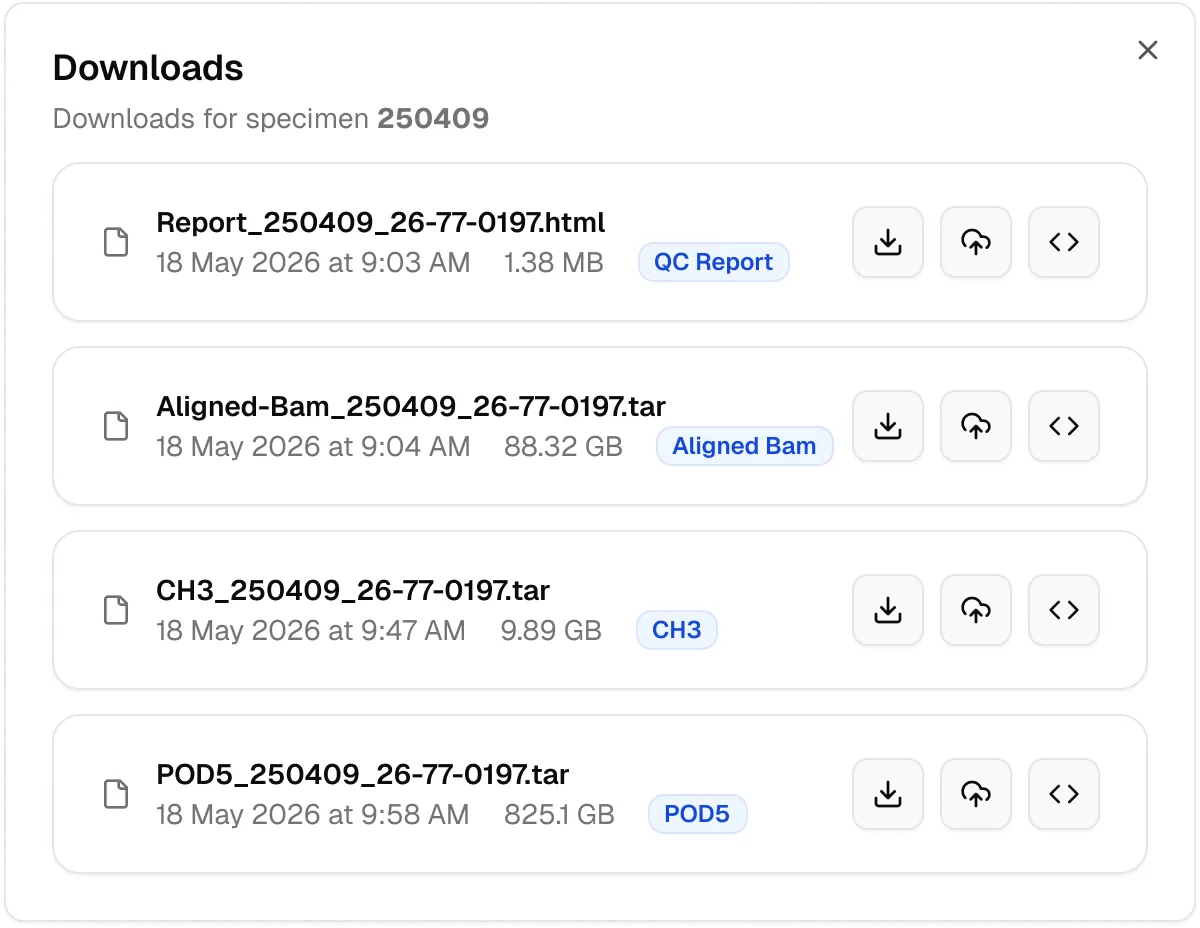
Download panel showing four files for specimen 250409 with names, sizes, dates, and download options.
  • Data Outputs
  • QC Report
    Sequencing metrics and run statistics
  • BAM
    Aligned reads
  • CH3
    Base modifications
  • POD5
    Raw sequencing data (available for an additional fee)
  • Data Delivery Options
  • Client Web Portal
    Manual download | Mac, Linux, Windows
  • AWS S3 Transfer
    Automated process | AWS to AWS
  • Command Line Script
    Manual download | Mac, Linux

Service Inclusions

Each project is supported by dedicated project management and cross-functional expertise across assay development, bioinformatics, and regulatory strategy. Renew provides proactive communication, transparent project tracking, and technical support from study design through data delivery.

Questions & Answers

What types of studies is Renew’s Telomere Sequencing designed to support?

Renew’s Telomere Sequencing supports studies requiring detailed characterization of telomere length and chromosome-end biology, including studies of aging and longevity, oncology, and biomarker discovery.

How is Renew’s Telomere Sequencing different from qPCR, TRF, or Flow-FISH?

Renew uses native long-read sequencing to measure telomere length while preserving subtelomeric context and native epigenetic modifications. Unlike methods focused primarily on global or population-level telomere measurements, the workflow provides chromosome arm-specific telomere length alongside subtelomeric methylation and structural information from extracted DNA.

What telomere and subtelomeric features does Renew’s assay measure?

The assay measures global and chromosome arm-specific telomere length, short telomeres, and telomere length heterogeneity. It also supports analysis of subtelomeric methylation, differentially methylated regions (DMRs), structural variants, and adjacent genomic context.

Does Renew’s Telomere Sequencing provide chromosome arm-level telomere length?

Yes. Renew’s workflow provides chromosome arm-specific telomere length measurements, enabling characterization of individual chromosome ends in addition to global telomere length and telomere length heterogeneity.

What information is included in a Telomere Sequencing report or data package?

Standard deliverables include telomere length measurements, chromosome arm-specific results, sequencing QC metrics, and sequencing data. Subtelomeric methylation, structural variant, and other project-specific analyses can be incorporated based on study objectives.

What sample types and input requirements are compatible with Telomere Sequencing?

Telomere Sequencing is compatible with high-molecular-weight genomic DNA from human and other eukaryotic organisms, including DNA derived from fresh, frozen, cultured, and biobanked samples. Project-specific input requirements are provided during study planning.

Can Renew support custom analysis or study design?

Yes. Renew provides experimental design consultation, bioinformatics support, QC review, and post-project technical consultation. Custom analyses can be developed around telomere length, subtelomeric methylation, structural variation, and other chromosome-end features based on study objectives.

Renew combines platform flexibility, nanopore expertise, and operational excellence to resolve areas
of the genome that standard approaches cannot.
Contact Us