Current blood biomarkers for neurodegenerative disease largely reflect aggregate pathology or downstream injury responses and provide limited insight into which brain regions or neuronal populations are actively affected. Cell-free DNA (cfDNA) offers a complementary signal because it retains methylation patterns linked to tissue and cellular origin, enabling cell-of-origin analysis from blood.
NeuroLens applies native nanopore methylation sequencing to generate a brain methylation atlas and deconvolute plasma cfDNA. For this proof-of-concept application, whole-genome methylation references were generated from primary human cortical, dopaminergic, and spinal motor neurons, along with astrocytes, microglia, and Schwann cells. Derived classifiers were applied to blood plasma samples from Alzheimer's disease, Parkinson's disease, amyotrophic lateral sclerosis, and healthy controls.
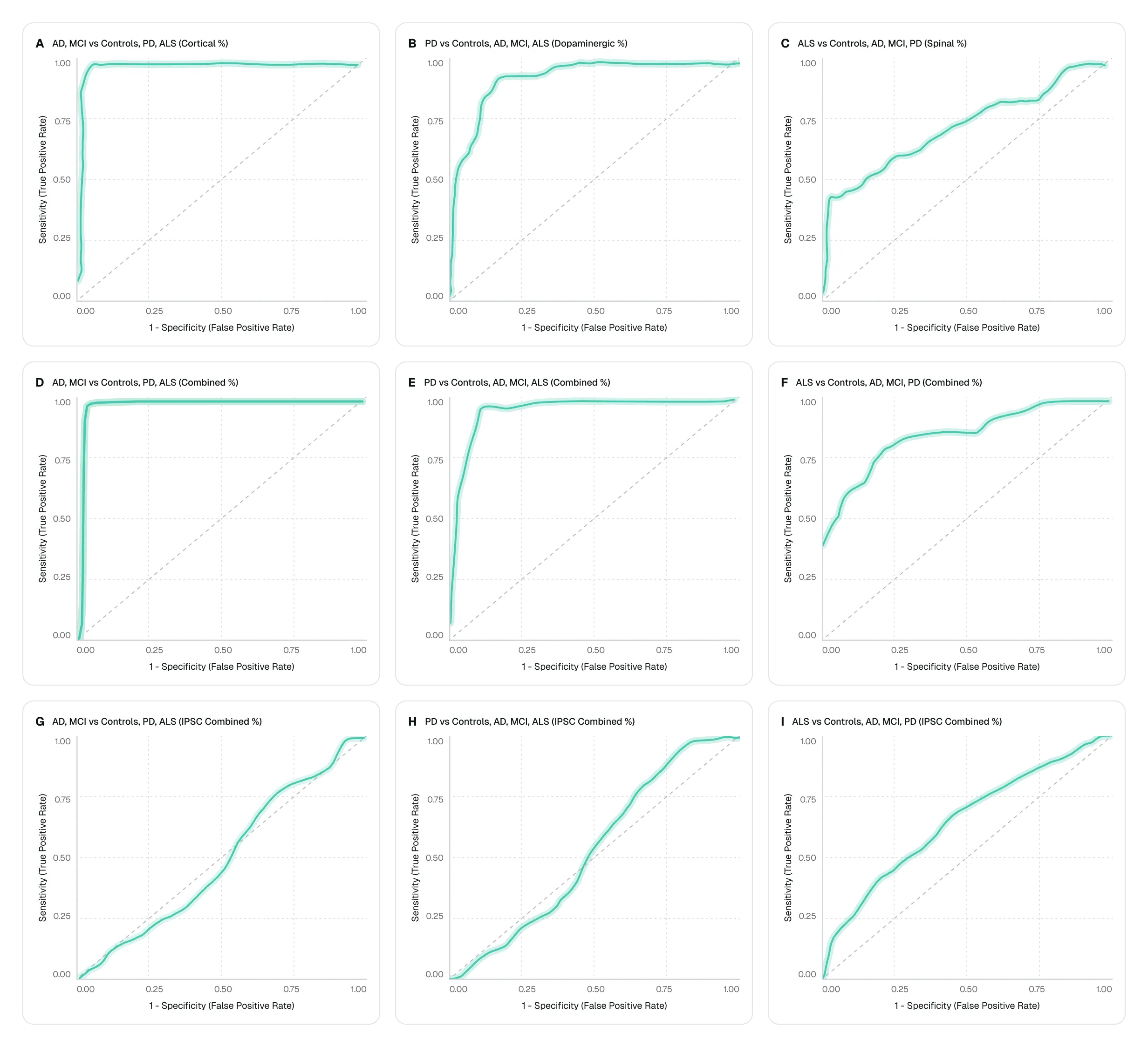
Figure 1. Integrated primary neuron cfDNA methylation signatures improve disease-group discrimination across neurodegenerative conditions. NeuroLens classifiers based on primary cortical (A), dopaminergic (B), and spinal motor neuron-like (C) cfDNA methylation signatures were evaluated across Alzheimer's disease (AD), Parkinson's disease (PD), amyotrophic lateral sclerosis (ALS), and control cohorts. Individual primary neuron classifiers were compared with integrated multi-neuron models (D–F), which achieved strong discrimination for AD (AUC = 0.98), PD (AUC = 0.96), and ALS (AUC = 0.86) in multi-disease settings. Both individual and integrated primary neuron classifiers outperformed analogous iPSC-derived cortical, dopaminergic, and spinal motor neuron classifiers (AUCs = 0.51–0.64), supporting the value of primary human neuron methylation references and multi-neuron cfDNA methylation deconvolution for biologically informed liquid biopsy profiling of neurodegeneration.