A Scalable Alternative to Methylation Arrays

MethylMap

MethylMap is Renew Biotechnologies' nanopore-based platform for scalable whole-methylome profiling.
By combining shallow whole-genome native methylation sequencing, proprietary library preparation, and array-compatible analytical workflows, MethylMap enables high-throughput epigenetic profiling.
MethylMap captures native DNA methylation without bisulfite conversion or PCR amplification, supporting genome-wide biomarker discovery, epigenome-wide association studies, and population-scale research.

MethylMap Supports Whole-Methylome Discovery and Large-Scale Cohort Analysis

Whole-Methylome Discovery

Generate Genome-Wide Epigenetic Insights Beyond Fixed Array Content
Regional Methylation Analysis
Characterize methylation patterns across genomic regions.
Integrated Genetic and Epigenetic Analysis
Link sequence variation with native methylation patterns.
Novel Biomarker Discovery
Discover methylation signatures linked to biological phenotypes.

Large-Scale Cohort Analysis

Enable High-Throughput Epigenetic Profiling Across Research Populations
Epigenome-Wide Association Studies
Identify methylation associations across large research cohorts.
Cohort Stratification
Identify molecularly distinct subgroups within study populations.
Large Population Studies
Scale methylome profiling across high-throughput cohorts.

MethylMap Differentiation

Key Advantages

circular graph shape icon
Broader, genome-wide methylation coverage beyond predefined probe targets
bars and graphs icon
Native methylation (5mc, 5hmc, 6ma) without bisulfite-associated damage or PCR-related bias
dotted bow tie icon
Array-compatible analysis workflows for QC, summarization, and differential methylation

Platform Architecture / Workflow

Proprietary gDNA library preparation
5x nanopore sequencing
.CH3 methylation file generation
ModSeqR analysis and visualization
Array-compatible analysis workflows
General Discovery
Tissue of Origin

General Discovery

Where structural variation and methylation jointly shape tumor biology, native long-read sequencing provides critical resolution. Many cancers involve large rearrangements and epigenetic changes that are difficult to profile with short-read or array-based approaches alone.

To demonstrate this approach in oncology, whole-genome MethylMap data from ovarian, lung, and lymphoma tumor samples were evaluated for methylation coverage and variant detection. Even at low coverages, MethylMap supported methylation profiling and detection of large variants, highlighting its potential for scalable oncology research.
Bar chart showing percent unique CpG sites covered at sequencing depths 5x, 10x, 15x, and 30x dWMS.
Figure 1. MethylMap maintains genome-wide CpG coverage across sequencing depths. Bar plots show CpG coverage at ≥1x, ≥5x, ≥10x, and ≥15x across 5x, 10x, 15x, and 30x genomic coverage. Pooled ovarian, lung, and lymphoma tumor (n = 3). Even at 5x coverage, all unique CpGs were covered at least once, supporting scalable methylation profiling from discovery to regional analysis.

Tissue of Origin

Tissue- and cell-of-origin studies use methylation patterns to infer the source of circulating DNA, supporting liquid biopsy and biomarker development. Traditional approaches can miss informative regional patterns when tissue-specific signals fall outside fixed array content or are reduced by bisulfite-related damage.

MethylMap provides broader native methylation context across tissue-informative regions, enabling more detailed tissue-of-origin estimation for translational studies and circulating DNA applications.
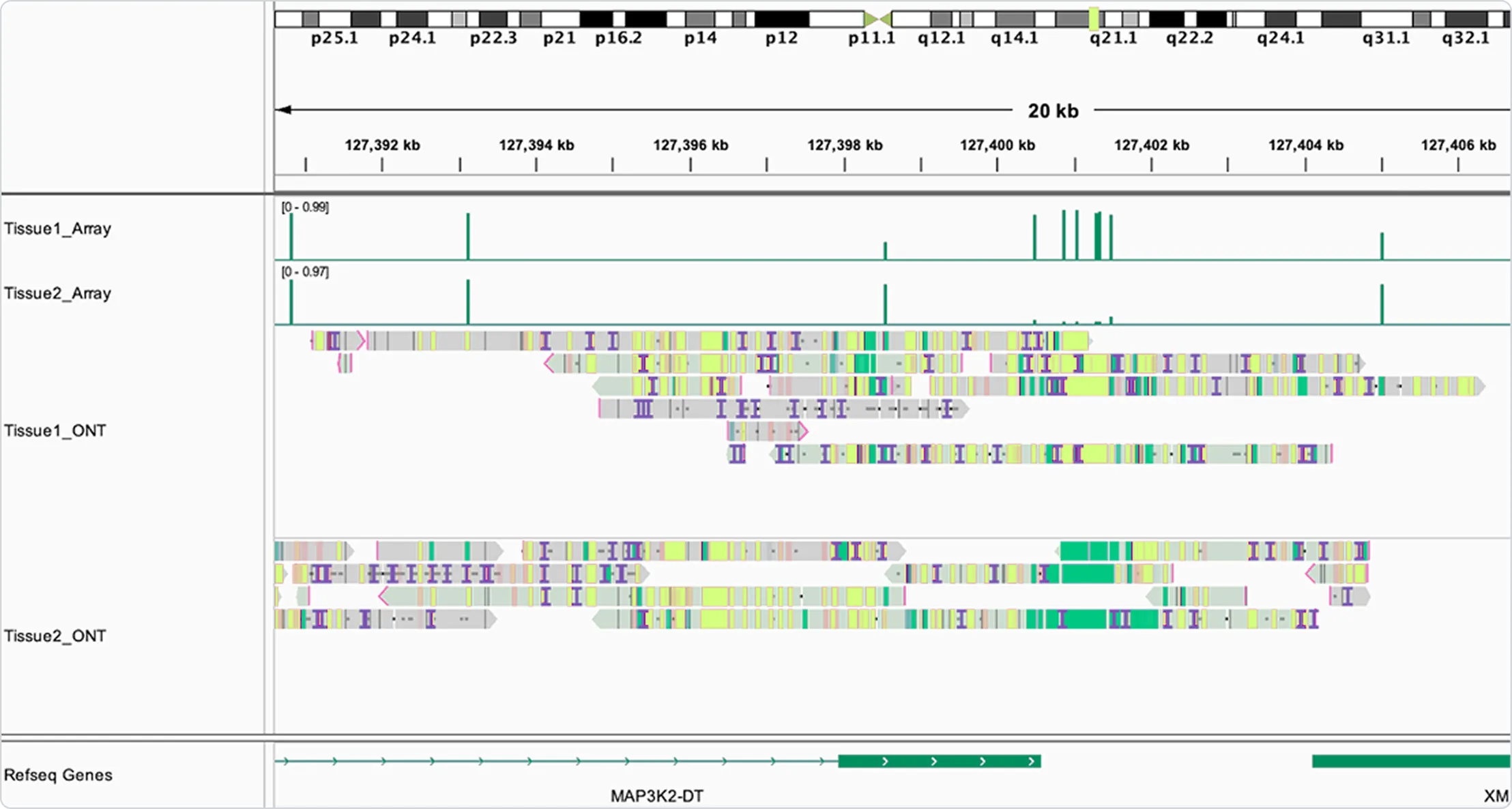
Genomic visualization showing gene MAP3K2-DT with methylation patterns across two tissues and gene annotations.
Figure 2. MethylMap expands CpG resolution for tissue-of-origin analysis. Across a representative 15 kb region, MethylMap detected ~15x more CpG sites than the EPIC methylation array while maintaining concordance at overlapping loci. Each ONT track represents a single read, with red indicating methylated CpGs and blue indicating unmethylated CpGs.

Questions & Answers

What types of methylation studies is MethylMap designed to support?

MethylMap is designed for large-scale methylation research, including regional methylation analysis, epigenome-wide association studies (EWAS), biomarker research, population-scale cohort studies, tissue-of-origin research, and translational epigenomics.

How is MethylMap different from methylation arrays or bisulfite-based methods?

MethylMap sequences native DNA, eliminating the need for bisulfite conversion or PCR amplification and the associated DNA damage and amplification bias. Unlike methylation arrays, which interrogate predefined probe sets covering only a fraction of genomic CpGs, MethylMap enables genome-wide methylation profiling while simultaneously capturing native sequence information.

Does MethylMap provide sufficient depth for methylation analysis?

Yes. MethylMap is optimized for approximately 5x human whole-genome coverage, which provides broad genome-wide CpG coverage suitable for regional methylation analysis, biomarker research, and large-scale cohort studies.

What information is included in a MethylMap report?

Standard deliverables include sequencing quality metrics, aligned sequencing reads (BAM), native methylation outputs (CH3), quality control reports, and standard methylation analysis results. Optional custom bioinformatics and downstream analyses are also available.

What sample types and input requirements are compatible with MethylMap?

MethylMap is performed on purified genomic DNA (gDNA). Standard projects require 1 µg DNA, with 500 ng accepted as the minimum input.

Can MethylMap support biomarker discovery, validation, or translational studies?

Yes. MethylMap is designed to support biomarker research, translational research, and population-scale epigenetic studies by combining genome-wide native methylation profiling with scalable sequencing and array-compatible analysis workflows.

How does Renew support custom analysis or study design for MethylMap projects?

Renew provides scientific consultation spanning study design, sequencing strategy, bioinformatics, and custom downstream analyses. Teams can also leverage proprietary CH3 and ModSeqR workflows alongside tailored analyses to support project-specific research objectives.

Explore MethylMap for Your Research Program
Apply MethylMap to epigenome-wide association studies, biomarker discovery, and population-scale research. Contact us to discuss pilot projects, study design, and bioinformatics support
Contact Us