Start A Project
Close-up of clear plastic wells in a laboratory 96-well plate used for experiments.

Overview

Direct RNA Sequencing is a standard Oxford Nanopore Technologies (ONT) service for directly sequencing native RNA molecules. The workflow does not require reverse transcription, cDNA synthesis, or PCR amplification, preserving transcript structure, poly(A) tail features, and epitranscriptomic signal for long-read RNA analysis.
  • Full-length transcript and isoform characterization
  • Reverse transcription- and PCR-free sequencing
  • Epitranscriptomic feature profiling from native RNA
  • Flexible input compatibility across common RNA inputs
DNA icons
Long-Read Transcriptomics
Full-length transcript and isoform analysis
Splice-variant and complex transcript resolution
interesting process icon
Epitranscriptomic Profiling
m5C, m6A, and pseudouridine signal analysis
A-to-I RNA editing and additional modifications
dotted bow tie icon
Research & Translational Applications
Transcript annotation and biomarker discovery
RNA therapeutic characterization and QC support
Technology
Workflow
Performance
Data Outputs

Technology and Compatibility

Direct RNA Sequencing applies native ONT long-read sequencing to RNA from diverse organisms and sample types, enabling transcript-level analysis across human, animal, plant, microbial, and non-model species.
  • Compatible with
  • RNA from human, animal, plant, microbial, and non-model organisms
  • Total RNA, poly(A)-enriched RNA, and ribodepleted RNA preparations
  • Research, translational, and RNA product characterization workflows
  • Component
    Technology
  • Sequencing Chemistry
    Native Oxford Nanopore RNA Sequencing
  • Preparation
    Standard ONT-compatible RNA preparation
  • Sequencing Platform
    Oxford Nanopore PromethION

Workflow

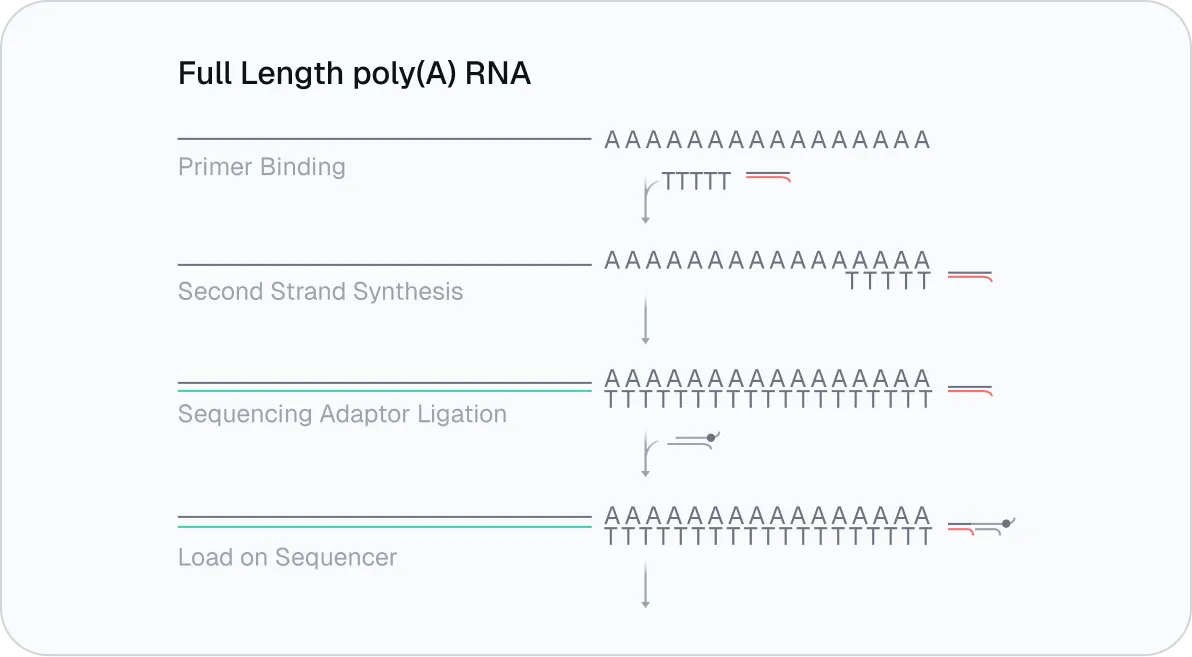
Direct RNA Sequencing uses ONT’s native long-read workflow. Renew provides full-service support from RNA extraction through sequencing, analysis, and data delivery.
Diagram showing RNA workflow: primer binding, strand synthesis, adaptor ligation, and loading on sequencer.
Figure 1. Oxford Nanopore Technologies Direct RNA Sequencing library preparation workflow (SQK-RNA004). 
  • 1. RNA Extraction
    High-quality RNA is isolated from submitted samples.
  • 2. Library Preparation
    RNA is prepared using ONT’s SQK-RNA004 library preparation.
  • 3. Long-Read Sequencing
    Native RNA sequencing is performed on the PromethION platform.
  • 4. Data Analysis
    Sequencing data are processed through automated analysis pipelines.
  • 5. Data Delivery
    Results are delivered through the customer portal or AWS S3.

Sequencing Performance

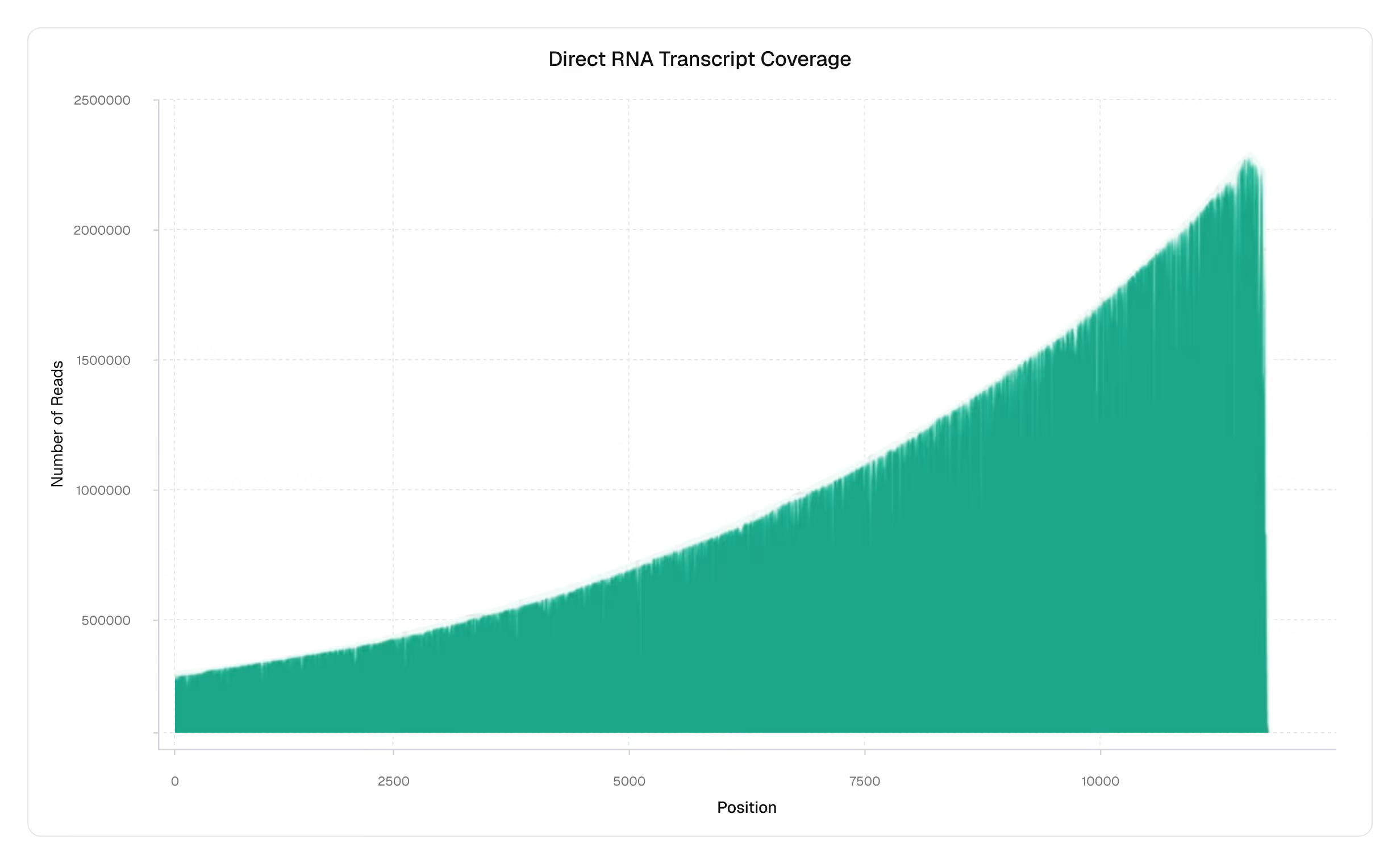
Coverage and yield vary by sample type, input quality, and study goals. Representative performance metrics shown below are based on human tissue samples. Direct RNA sequencing can also be performed for other species of interest.
Area chart showing increasing direct RNA transcript coverage with reads rising to over 2 million by position 12000.
Figure 2. Coverage summary of RNA transcripts.
  • Metric
    Typical Performance
  • Samples per Flow Cell
    Up to 24
  • Average Output
    20Gb
  • Average Read Length
    Up to 2.5kb
  • Epigenetic Coverage
    > 95% complexity
  • Available Epigenetic Signals
    m5C, m6A, inosine, pseU

Bioinformatics and Data Outputs

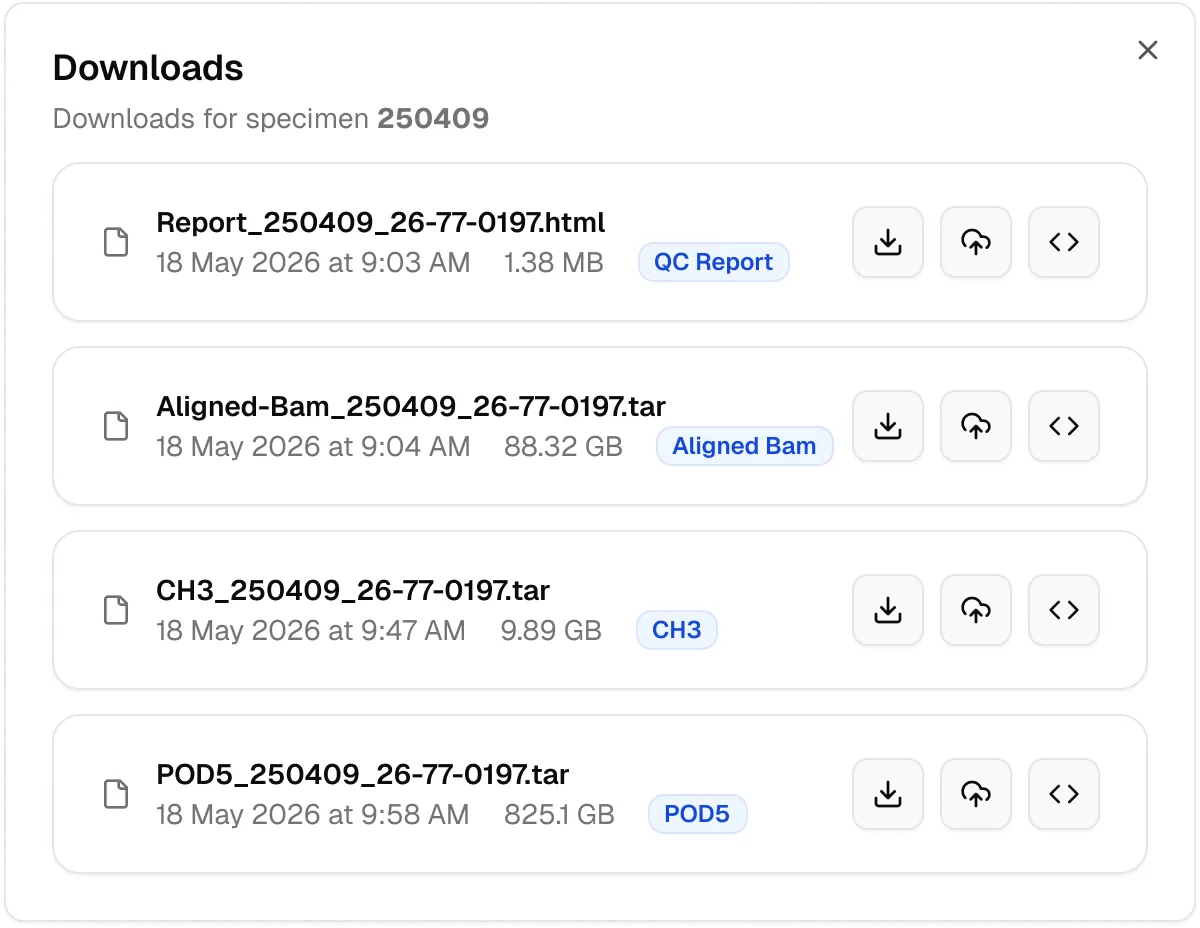
Data outputs are designed to optimize data storage, transfer, and analysis. Methylation data is provided in a unique CH3 file format which reduces data size by up to 95%. This memory-efficient format stores data in an on-disk database, enabling larger-than-memory tasks.
Renew developed the ModSeqR R package, which converts ONT methylation data into array-like formats compatible with tools such as minfi, DMRcate, and chAMP. This solution empowers researchers to efficiently leverage dWMS data within familiar frameworks, facilitating advanced epigenetic insights.
Download panel showing four files for specimen 250409 with names, sizes, dates, and download options.
  • Data Outputs
  • QC Report
    Sequencing metrics and run statistics
  • BAM
    Aligned reads
  • CH3
    Base modifications
  • POD5
    Raw sequencing data (available for an additional fee)
  • Data Delivery Options
  • Client Web Portal
    Manual download | Mac, Linux, Windows
  • AWS S3 Transfer
    Automated process | AWS to AWS
  • Command Line Script
    Manual download | Mac, Linux

Service Inclusions

Each project is supported by dedicated project management and cross-functional expertise across assay development, bioinformatics, and regulatory strategy. Renew provides proactive communication, transparent project tracking, and technical support from study design through data delivery.

Questions & Answers

What is direct RNA sequencing and how does it differ from traditional RNA-seq methods?

Direct RNA sequencing reads full-length, native RNA molecules directly using Oxford Nanopore technology, without reverse transcription or PCR amplification. Unlike cDNA-based or short-read RNA-seq, it preserves RNA sequence, structure, and chemical modifications, enabling more accurate analysis of isoforms, splice variants, and RNA modifications.

How can direct RNA sequencing service support transcriptomics studies?

Direct RNA sequencing generates full-length transcript data while preserving native RNA modifications. This facilitates isoform-level resolution, accurate splice variant detection, and improved transcript annotation, supporting detailed transcriptomic and epitranscriptomic analysis.

What types of RNA expression analysis can be performed using Renew’s Direct RNA Sequencing?

Direct RNA sequencing supports a wide range of RNA expression analyses, including isoform-level quantification, differential gene expression, fusion transcript detection, long non-coding RNA characterization, and post-transcriptional modification profiling. The approach also supports identification and annotation of RNA methylation sites, such as 5mC and 6mA, and downstream enrichment analyses.

What are the sample requirements for Renew’s Direct RNA Sequencing services?

Renew accepts high-quality total RNA or poly(A)+ RNA from a wide range of organisms, including human, animal, plant, bacterial, and viral sources. All samples must be non-infectious and certified as such prior to submission. Questions regarding sample quality, preparation, or shipment can be directed to our team at info@renewbt.com.

What advantages does direct RNA sequencing offer over cDNA-based approaches?

Direct RNA sequencing profiles native RNA molecules without reverse transcription or PCR amplification, eliminating associated biases. This approach preserves RNA modifications, delivers long reads for improved isoform resolution, and more accurately represents transcriptome complexity, making it well suited for RNA expression and isoform analyses.

Does Renew offer bioinformatics support for Direct RNA data?

Yes, we offer comprehensive bioinformatics support for nanopore RNA data, including custom analysis workflows and one-on-one collaboration with our team to support data interpretation and generation of publication-ready insights.

Renew combines platform flexibility, nanopore expertise, and operational excellence to resolve areas
of the genome that standard approaches cannot.
Contact Us