Start A Project
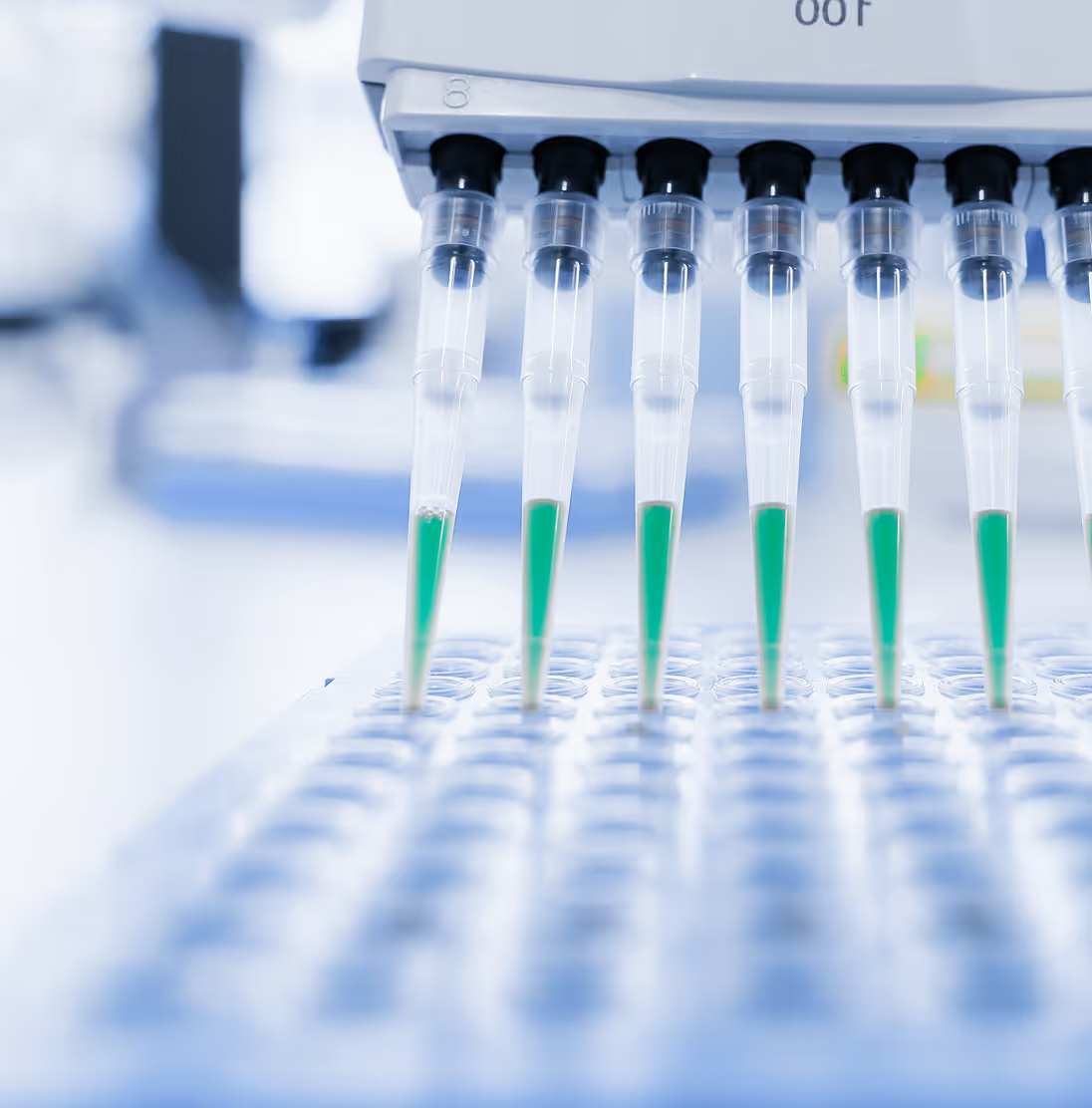
Close-up of a multi-channel pipette dispensing green liquid into a multi-well plate in a lab.

Overview

Direct Methylation Sequencing (dMS) combines proprietary library preparation protocols with native Oxford Nanopore cfDNA sequencing to support cfDNA methylome profiling and liquid biopsy biomarker development without bisulfite conversion or PCR amplification.
  • Native cfDNA sequencing optimized for methylation analysis
  • Native 5mC, 5hmC, and 6mA profiling without bisulfite conversion
  • Integrated sequence and methylation analysis in a single workflow
DNA icons
Multiomic Liquid Biopsy
Integrated genomic and epigenetic analysis from one dataset
Expanded CpG coverage beyond traditional methylation arrays
interesting process icon
Broad Sample Compatibility
Compatible with plasma, serum, CSF, and seminal fluid
Flexible support for research and biomarker development
dotted bow tie icon
Tissue-of-Origin Analysis
Native methylation profiling of circulating cfDNA fragments
Cell- and tissue-of-origin inference and characterization
Technology
Workflow
Performance
Data Outputs

Technology and Compatibility

dMS applies native ONT sequencing to cell-free DNA, enabling cfDNA methylome analysis and liquid biopsy biomarker discovery across diverse biofluids and research applications.
  • Compatible with
  • Human and animal cfDNA samples
  • Plasma, serum, CSF, and seminal fluid biofluids
  • Research, translational, and biomarker development workflows
  • Component
    Technology
  • Sequencing Chemistry
    Native Oxford Nanopore cfDNA Sequencing
  • Preparation
    Renew dMS library preparation
  • Sequencing Platform
    Oxford Nanopore PromethION

Workflow

Direct Methylation Sequencing uses Renew’s optimized native cfDNA sequencing workflow for methylome profiling and liquid biopsy analysis. Renew provides full-service support from cfDNA extraction through library preparation, sequencing, analysis, and data delivery.
  • 1. cfDNA Extraction
    High-quality cfDNA is isolated from samples.
  • 2. Library Preparation
    Proprietary dMS library preparation and adapter ligation.
  • 3. cfDNA Sequencing
    Native cfDNA is sequenced via PromethION platform.
  • 4. Data Analysis
    Sequencing data are processed through automated analysis pipelines.
  • 5. Data Delivery
    Results are delivered through the customer portal or AWS S3.

Sequencing Performance

Coverage and yield vary by cfDNA input quantity, sample type, multiplexing strategy, and study goals. Representative performance metrics for human cfDNA samples are shown below.
  • Metric
    Typical Performance (Human Samples)
  • Samples per Flow Cell
    Up to 24
  • Average Coverage
    0.1x-1.0x
  • Average Read Length
    ~500 bp N50
  • Available CpG Coverage
    > 95% CpG coverage
  • Available Epigenetic Signals
    5mC, 5hmC, 6mA, non-CpG methylation

Bioinformatics and Data Outputs

Data outputs are designed to optimize data storage, transfer, and analysis. Methylation data is provided in a unique CH3 file format which reduces data size by up to 95%. This memory-efficient format stores data in an on-disk database, enabling larger-than-memory tasks.
Renew developed the ModSeqR R package, which converts ONT methylation data into array-like formats compatible with tools such as minfi, DMRcate, and chAMP. This solution empowers researchers to efficiently leverage dWMS data within familiar frameworks, facilitating advanced epigenetic insights.
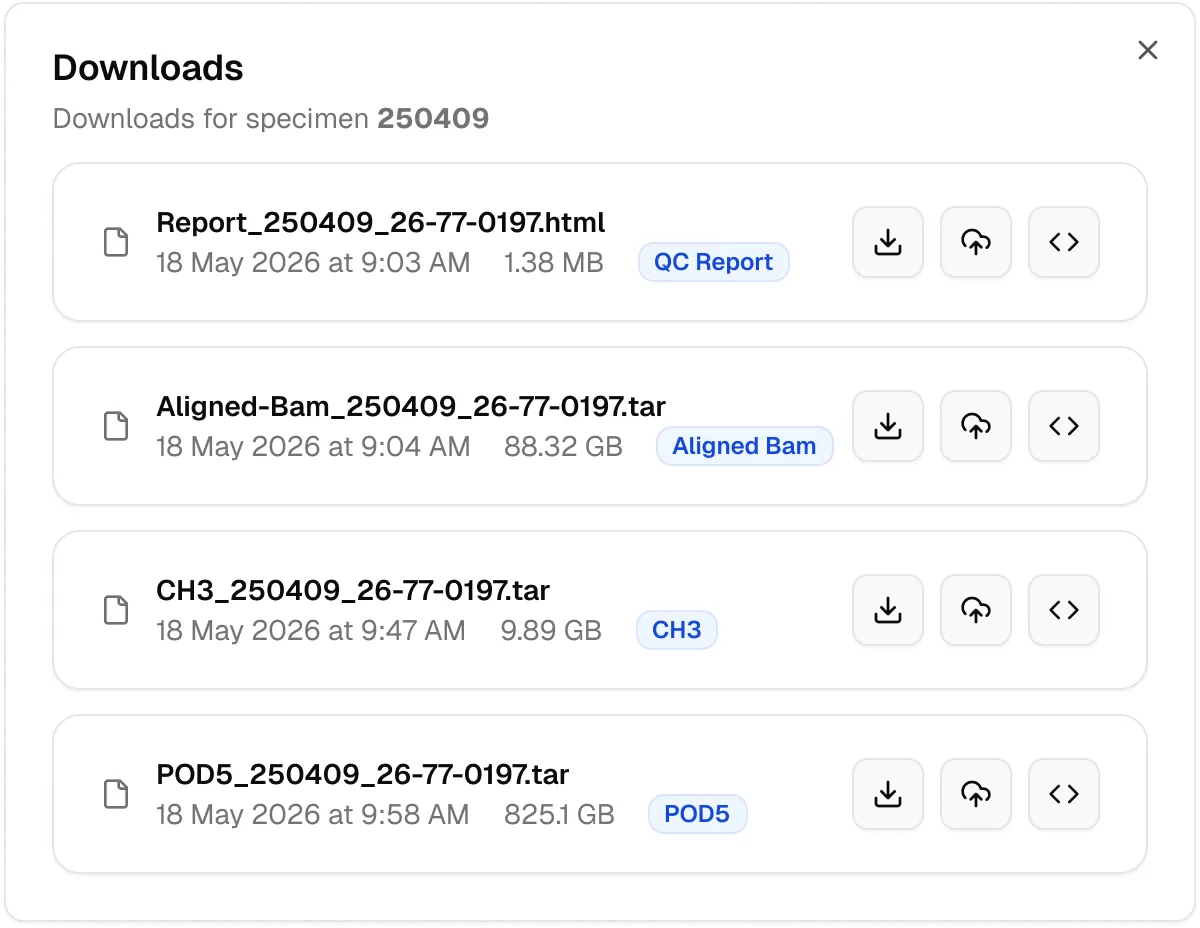
Download panel showing four files for specimen 250409 with names, sizes, dates, and download options.
  • Data Outputs
  • QC Report
    Sequencing metrics and run statistics
  • BAM
    Aligned reads
  • CH3
    Base modifications
  • POD5
    Raw sequencing data (available for an additional fee)
  • Data Delivery Options
  • Client Web Portal
    Manual download | Mac, Linux, Windows
  • AWS S3 Transfer
    Automated process | AWS to AWS
  • Command Line Script
    Manual download | Mac, Linux

Service Inclusions

Each project is supported by dedicated project management and cross-functional expertise across assay development, bioinformatics, and regulatory strategy. Renew provides proactive communication, transparent project tracking, and technical support from study design through data delivery.

Questions & Answers

What is Direct Methylation Sequencing (dMS) for cell-free DNA?

Direct Methylation Sequencing (dMS) is a bisulfite-free, Oxford Nanopore–based whole-genome sequencing service for cell-free DNA (cfDNA). It uses unbiased nanopore sequencing with proprietary library preparation optimized for short cfDNA fragments to preserve native DNA methylation and other base modifications.

Can dMS for cfDNA be used for liquid biopsy research?

Yes. dMS can be used to analyze genome-wide methylation patterns in circulating DNA fragments from blood or other fluids. It is well suited for tissue-of-origin analysis and liquid biopsy research without the need for targeted panels or prior assumptions.

What makes Renew’s cfDNA methylation technology different from traditional methods?

dMS uniquely combines bisulfite-free, native Oxford Nanopore sequencing with proprietary cfDNA-optimized library preparation to preserve native epigenetic context. Unlike bisulfite- and PCR-based workflows, it analyzes methylation directly from fragmented cfDNA, enabling unbiased, genome-wide detection of methylation and other base modifications for discovery-driven liquid biopsy research.

How does Renew’s dMS for cfDNA improve sensitivity?

By avoiding chemical conversion and amplification, dMS minimizes DNA damage and representation bias. This preserves more cfDNA molecules and their methylation signals, enabling sensitive, single-molecule methylation analysis even from low-input or low-abundance samples.

Renew combines platform flexibility, nanopore expertise, and operational excellence to resolve areas
of the genome that standard approaches cannot.
Contact Us